Thursday, 15 July 2010

After the storm

Last night and this morning we had some very unseasonal weather, high winds and torrential rain. I spent the morning during the rain sorting out stuff to pack and various bits of paper that I need for our journey south. I also finished another set of mounted prints that are to go in a small gallery/restaurant here. Going over this morning it was interesting to see what was remaining from the last 'batch' I took there some while ago. The ones that were left, I have to admit, I only put in originally because they were of one of many of the seals  that haul out near by. I personally don't think that seal pictures are particularly interesting unless they are either close up of the face or are doing something. My kids used to describe seals which had hauled out as looking like big, grey, slugs !


Whenever I go away on holiday - whether its here or when I was down south - I always like to have a last visit  to a favourite spot. Down south it was to a trig point along an old Roman road which is a special place for me, here, as I'm sure you may guess, it's Lamba Ness. By lunch time the rain had stopped and at one time the sun even came out briefly. It wasn't really a photo trip out (but the camera is always on the seat any how) but more like getting my 'fix' before we head for the hustle and hassle of way down south. As I drove down to the headland there wasn't much happening apart from the ever present - and ever noisy Oystercatchers and a few Starlings preening themselves now the rain had stopped.


After staying there for a while it was back for a quick visit to Skaw. Judging by the burn at Skaw, there had been a lot of water down it during the night as a lot of the grass on the banks had been flattened in the direction of the sea.


The croft at Skaw (Britain's most northerly house)

It never ceases to amaze me how the shape of the beach where the burn enters into the sea can change so much in such a short time. I'd love to a have an old digital SLR (no not my trusty 40D) and set it up to do some time lapse shots of the beach and its changes. Some days it can be a gentle slope down in to the burn at the beach then other days there can be a 5ft vertical drop where the action of the sea and water coming down the burn almost create a mini gorge.

Skaw beach looking towards Lamba Ness

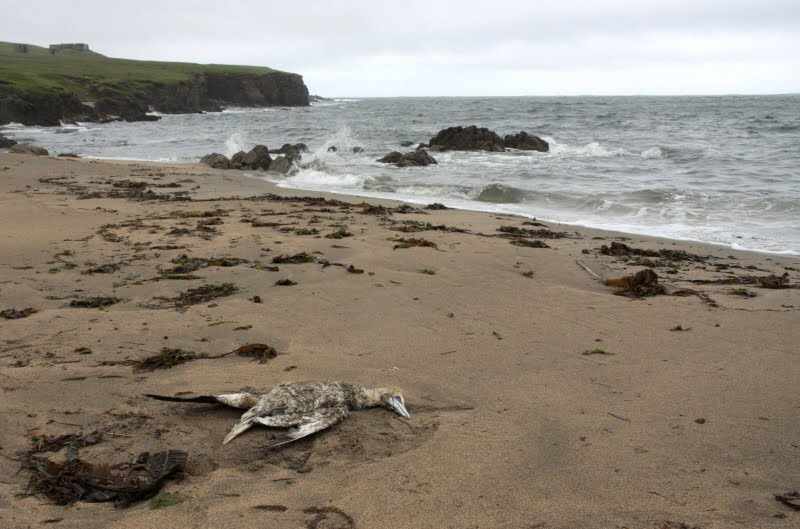
Turning northwards along the beach, I could see an obvious whitish carcase on the beach and judging by the size, I guessed it was a Gannet. Sure enough it was. It's always sad to see these magnificent birds washed up like this and it isn't usually obvious how they died. Sometimes when it is a juvenile, I assume that it didn't learn how to fish and maybe it starved, who knows? Going over to check for a ring, I saw that it wasn't natural causes that had ended this birds life. Around its body it had a plastic band around 3/4 inch wide - the sort used to secure large packages and boxes. The band was intact so all I can assume is that either it swam into it or by incredible odds, dived into it.

After the storm

The only other thing of note on the beach at Skaw was a party of 11 Turnstones, these birds must be returning south from breeding or are failed breeders - summer really is almost over, if you're a wader.

As I headed back southwards, I stopped in at Norwick beach for a short while as there was a lot of tern activity there. Just below where I stopped the car, a dozen or so Arctic Terns called noisily from the boulders just up from the waters edge. Amongst them were a number of recently fledged young who chased flies among the seaweed covered shore - and not catching many !

adult Arctic Tern

By Monday evening I'll be a bit nearer the Arctic in Iceland, so there won't be a post for over a week. Cheers.

    Robbie


Wednesday, 14 July 2010

Summer's Over ?

 Sorry about the title, but as far as some of the breeding birds here, it is. As I said previously, I'm off away for a while (including a trip to Iceland) and by the time I get back here in August, both the Phals' and Puffins will have gone and also many of the other breeding birds will have left their breeding habitats and gone quiet. 

At the beginning of last week, I was really chuffed to go into the local store and see on the cover of  Shetland Life  one of my pictures. It was the one of a Common Tern food pass which has been on several forums and also was 'Photo of the Week' on the Birdguides website last year. I'd been asked to submit 15 pictures to the magazine for possible inclusion in their gallery section and then got 4 pages. For me personally, what it has done, is for local folk to see what I try and do when they see me out and about in the car, parked up and the camera out of the window.


Last weekend, we took a trip south to Sumburgh firstly to take my better half to the airport then up to the head as the RSPB had an 'open day' there. On the ferry crossing between Yell and Mainland, we were lucky to get distant views of one of the pods of Orcas that have been seen in Yell Sound almost every day in the last week. There are now several pods around Shetland and lets hope that one of them heads north to Unst. (but not when I'm away please)

There were very few Puffins around which didn't really surprise me as it was very warm (by Shetland standards at any rate, 20 degrees !) and any that did come in to burrows in full sunshine, they went straight down. I think it must be another record for me as I only took 2 pictures and they were both of my kids.


A 'tiger' on the loose at Sumburgh

Despite the relative lack of photo opportunities, it was a great afternoon chatting with birders and bird wardens that I know and also putting faces to names of folk I've come across on the web. 

The following day (Sunday) was a total washout. It looked and felt more like November than the height of the summer. Monday morning was much better but I spent most of the morning mounting photographs for a forthcoming exhibition here on Unst for the UnstFest at the Bluefrog Studio at which I did some carpentry and joinery work recently.


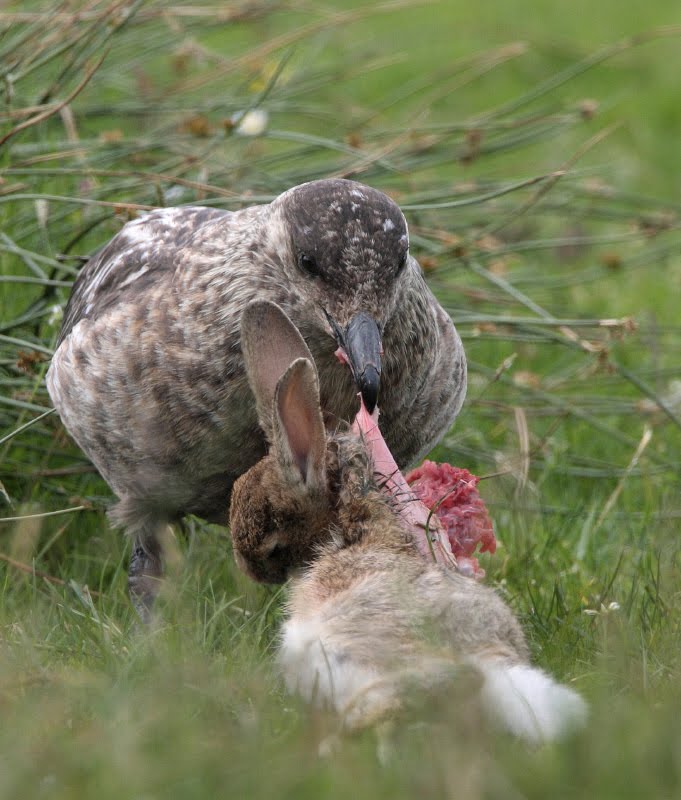
Tuesday was spent working as the kids were in the local crèche for the day - although I did manage to get finished early and unwind after a very busy morning. I took a drive up north to my favourite bit of the island to Lamba Ness and Skaw. At Lamba Ness I sat and watched Gannets fishing for a while and then another couple of photogs' arrived so I moved off. On the way down to the head, I'd seen a couple of Bonxies feeding on a carcase, so I had the camera ready on my lap should they still be there on my return along the road. Fortunately they were still there, but on rolling to a standstill, one took off. The other however, after watching me for a short while, continued to feed on what I now saw was a dead rabbit.


From Lamba Ness, I headed for Skaw with the intention of walking out to an area that I have seen Tysties (Black Guillemot) on a cliff face that is easy to get photographs of them. For what ever reasons there were no Tysties but only Fulmars. On the walk back, a male Wheatear landed near by and allowed me to crawl fairly close before it hopped off to catch a fly. Wheatears are one of my favourite passerines here and it really is the end of the summer when they have all moulted and look like females or juveniles and are then soon gone.


male Wheatear

Heading back up the road later (time was now not on my side and kids had to be picked up from crèche) I passed by the area where there has been an Arctic Skua territory close by the roadside (the same one as the pale phase skua I mentioned in the last post). Today there was no pale phase, but a dark phase one sitting on a hillock a short distance away. As I coasted to a stop the bird took off, but instead of flying off some distance, it turned around and came back to the same area. It did this a second time and then a third - this time I was hoping to be ready and pre-focussed on the spot where I thought it would pass. Fortunately for me it did and I got some shots. 


'Dark Phase' Arctic Skua

First thoughts could be that the bird had a nest nearby, but watching the bird for a while, I was pretty sure by its overall behavior, that it hadn't. With all of the Bonxies and gulls around, I don't think any ground nesting bird would leave its nest unattended.

Again, as I mentioned in my last post, I was going to have one last try for Phals' on Fetlar and today was it ! It wasn't going to be just a jolly out birdwatching, I was hoping to go and see someone about some work (although they didn't know I was going). Well, as they say 'the best laid plans o' mice and men' etc etc. Firstly, the 10.20 ferry was fully booked and then the person I was going to see had gone away again for a week (she had only returned home last week after a trip). I managed to get booked on the 11.50am ferry and had a pleasant crossing chatting to the skipper in the wheelhouse about the Orcas that had been in Bluemull Sound last week - and no, I didn't see them !

Getting ashore, I headed straight for Loch of Funzie to check for any Rednecked Phals' but all I got there was a Red-throated Diver not far from the shore and as the light was behind it I didn't bother with the camera. It has been a poor year for phalaropes showing at Funzie, the weather has not been ideal - too windy, not enough sunshine, but no one knows for sure why they haven't been there - they are certainly still breeding, but they're just not turning up to have their pictures taken ! Lots of people (including me) have gone away  disappointed because they've not seen any; I was recently told that some folk have even phoned up the RSPB wanting to know what they are going to do about it. Get real, these are wild birds and we can't do much about the weather. I heard stories from last year of really selfish people and really bad behaviour caused partly by the birds not showing there on cue, maybe these folks should be 'named and shamed' ? Hopefully, this year is just a blip regarding the phals' as Fetlar gets a lot of much needed tourism from these beautiful birds.

Shortly after a tea in the village hall, I headed for Tresta Beach and hopefully a few terns and loads of Bonxies, not to be however. Arriving down at the beach car park, my way was blocked by a gang laying tarmac outside the new graveyard, so off it was to another spot. I parked down on the foreshore not far from Broch Lodge for a time before another car pulled up and broke the tranquility by leaving the engine running for quite a while.

Broch Lodge, Fetlar

Broch Lodge is currently uninhabited but is due to be renovated in the future once sufficient funds have been raised. The first phase however, is due to start fairly soon to make it wind and water tight.

Back on the road again and heading for the ferry terminal, I spotted a snipe sitting on a roadside fence. The only lens I had with me in the front of the car was the 500 so I'd have to 'make do'. I rolled to a standstill, cut the engine and got a number of full frame shots. It is too big in the frame and the composition is wrong but the alternative was to try and get my 300 from the back of the car which would have probably scared the bird off.


After a dozen or so shots, the bird turned around and just dropped down into the field behind.

It wasn't long before I was back at Hamars Ness waiting to board the the 'Geira' for the journey back firstly to Yell and then across to Unst. 

The 'Geira'

By now the wind had picked up as the forecast said it would, I just hope it slackens off before the Northlink boat on Friday ! While waiting for the ferry to leave Gutcher on Yell, I was treated to a number of Gannets diving for food just off of the terminal. Unfortunately, almost all of the dives were either out of sight around the breakwater or too far out to photograph.


It's at times like this, that I wish I had a decent zoom lens, maybe something like a 300-500 (yeh, I know it doesn't exist) and also the money to buy one if it did !

                        Robbie

Friday, 9 July 2010

Have I missed summer ?

Here we are in the first week of July and we are having some unseasonaly strong winds. Saying that, we have had a few nice days where the temperature has soared to a balmy 18 degrees. I don't think I could cope for long in the heat that has been occurring down south recently. I feel that this year again I'm going to miss catching up with the Phals' on Fetlar as I'm running out of time before we go away and by the time I get back they will have gone. I still have a few days left this coming week where I can pop over with my girls should the weather improve.

I don't know why, but many of my casual otter sightings are often when the weather is dull and this was the case early last week. I was driving along the road from Baltasound to the harbour past a usual otter fishing spot, when I saw two otters out on a seaweed covered rock with a large fish. It was the two mature cubs that I've been seeing lately (often with their mother) along this stretch of coastline. I have no idea which one caught the fish, but the other one certainly wanted a share of it !


It wasn't long after this peaceful moment of siblings sharing a meal that one of them decided enough was enough (or not enough to be more precise) and wanted the fish for itself. This was made obvious by several minutes of 'tug o war' before one of them let go and went off in to the water to fish for itself.


I had a good friend on mine visit last week who I have known for over twenty  years who is also a birder. He arrived on the Thursday morning from the Aberdeen ferry and once 'acclimatized' we headed off for an afternoons tour of the island starting at Skaw. On the way there, we passed a feeding curlew in a hay field that was quite confiding.

 Curlew

Continuing along the road, the next 'new' bird for Martin was a cracking pale phase Arctic Skua just by the turning for Lamba Ness. The dark phase are commoner here but the pale phase is also quite widespread. Arctic Skuas, like their cousins the Bonxies (Great Skuas) are also piratical in the way they obtain much of their food by stealing it  from other seabirds - in this case terns. They will also take eggs and nestlings if the occasion arises. The picture below is possibly the same bird, but was taken in 2009 (it was in the same area as this one)

'pale phase' Arctic Skua'

The following day started bright and sunny (but wasn't supposed to last) so we decided to head for Hermaness for Gannets, Puffins and Bonxies - and anything else that wanted to show. Even though it was sunny, it was still quite breezy and this along with the wind direction could affect the way the birds were behaving at the cliff top. On the way up, there were many Bonxies fairly near to the boardwalk  but they weren't reacting much so I didn't bother to take many pictures.

After three quarters on an hour, we arrived at the cliff top and stood and 'drank in ' the view. Having now been up there many times, the arrival at the cliff edge still thrills me. Martin took a few pictures and I started to walk on south towards the Puffins and Gannetry. A minute later I heard a call from Martin - ' Buzzard' , quickly going back, we then realized it was in fact a Honey Buzzard. There had been one a bit further south in Shetland a few days previously so this was probably the same one. It didn't hang about for long (not long enough for pictures sadly) and soon disappeared out of view down the west side of Unst. The rest of the afternoon was spent watching a few puffins and hundreds of gannets. Like I'd mentioned earlier, the wind had affected the birds in that there was virtually no updrafts on the cliffs (due to the wind direction) and so most of the birds were much lower down or just sitting around.

'mutual preening'

I think that this visit to Hermaness, must for me, be a record; - I only filled one 2gb card on my 40D !

Apart from the birds, we also saw a number of Red Admiral butterflies on the cliffs feeding on the Sea Pinks. This was one place that you would definitely not be wanting to get closer with a macro lens. The shot below was taken with the 500 +1.4 converter.

Red Admiral


On returning to the car, the rest of the day was taken up with a trip to the pub for a pint and some food (and we watched some football - even though I'm not a football 'enthusiast') and then to Lamba Ness to see the sun sink into cloud on the horizon at around 10.35pm.

Lamba Ness 10.35pm early July

The following day was still bright and sunny, but it was still very windy. In the morning we went to Norwick and then up to Saxavord to take in the view. Whilst there, we chatted to a friend of mine - who is an artist - who was up there cutting peat. I did have a go and all I can say is that it must be a back breaking task to cut, stack and then cart away hundreds of these brick shaped peats.
Returning to lower ground, we were treated to a cracking Red-throated Diver feeding close in to the beach at Haroldswick

  Red-throated Diver

Later we headed over to Westing to try and get a bit of shelter from the wind direction. But no matter where we walked it seamed to follow us around the coast.

For the last day of Martins visit, we headed for Fetlar, and, just like 3 out of the last 4 visits, it was wet and windy ! (I can't always choose nice days) We had no great expectations of seeing any Phals' and so we weren't disappointed when we didn't see any. We did spend a lot longer in the hide at Funzie than maybe I would normally do and despite the weather it was great just watching the commoner birds - but at least we were dry. Later on in the early evening, we enjoyed a splendid fish supper in Uyeasound village hall. These fish supers are regular events in the summer on Unst and are done by volunteers to raise money for local events etc and as anyone one will testify who has had one will say, they are fantastic.

The following day Martin left for the Aberdeen ferry and I had four days of work ahead of me (it's a hard life) . As I've said before, travelling to and from work here is hardly a chore as there is always something to see on the way - even if I do have to make a slight detour. A couple of days ago, I did just this and went to Skaw where there is a family of Dunters (Eiders) which are quite used to me sitting down by waters edge.

female Eider

After watching the birds for a while, the two females and one duckling, swam past me and then out over the breaking waves. Suddenly, there was panic and the birds flapped and paddled their way back towards the shore.


In the panic, I think the two mothers briefly lost sight of the offspring as it was engulfed by another breaking wave.


 - Fortunately it wasn't long before they were reunited.


It soon became very obvious what had caused the panic - two seals - I had a good view of the water and hadn't seen them coming. I've seen this behaviour several times before by seals - including one occasion where one tried catch a Great Northern Diver by coming up under it.


One of the culprits

It was very obvious that the seals weren't giving up and were still looking for the birds. Again the ducks fled but this time the adults left the duckling behind to fend for itself. I really thought I was going to see the duckling taken as a starter before the main course. Fortunately, the small bird did manage to find some energy and literally ran across the water after its mother which by now was 40 or 50 feet away.

Later  in the day, I took a drive over to Lamba Ness again to try and get a sunset - too few and far between lately. On the way, I passed a curlew territory with one of the pair standing on a fence post. I've seen this ringed bird a number of times but today it had something around the other leg. To me it looks like wool and is something that I've often seen on both waders and gulls and I can only assume that it collects as they walk through the sheep fields looking for food. Very occasionally I've seen it on both legs (tying them together) on birds and wonder if the birds can survive. 


Again, no sunset at Lamba Ness, the sun was going down into a large bank of cloud that stretched far out to the distant horizon in the north. Sadly my idea of doing a time lapse of the sun setting and then rising in the same shot without moving the camera, is now just another idea; as by the time I get back from a trip away, the distance between it will be too great. Hey ho.


                  Robbie

Sunday, 27 June 2010

Whimbrels and Whales

The day after seeing the Dotterel, we headed for Fetlar with the hope of seeing another pretty wader, Rednecked Phalarope. The day was rather windy (too windy for Phals') and also cloudy (also not not good for seeing Phals' on the Loch on Funzie) so I decided to make the most of it. On Funzie, there were four Red-throated Divers which were, as usual, out in the middle; and, just as I'd thought, no Phals' ! After an hour at Funzie, we headed off to Funzie Bay at the east of the island. While the others took a walk south around the bay, I walked a short distance and sat down out of the wind in a brief spell of sunshine. A few minutes later I was treated to a 'walk past' of a Whimbrel which didn't seem too bothered by me siting down just below the grassy cliff edge. Shetland has around 50% of the UK breeding population of Whimbrel with a large number of them breeding on Fetlar.


Whimbrel

Moving on from Funzie Bay, we headed for Tresta Beach. The beach at Tresta is usually very busy with fishing terns, bathing Bonxies and Arctic Skuas on the lookout for a relatively easy meal from the terns. On this windy day however, it was rather quiet apart from the ever present bathing Bonxies in the freshwater loch close by. At the loch, it was another one of those sort of days, the light was from behind me but the wind was blowing down the loch towards me. This meant that the Bonxies were flying in from behind me and then landing into the wind, this meant I usually got a rear view as they landed. If I moved my position, I was then shooting into a rather grey, flat light. Finally the sun came out briefly and I managed to get a few shots - but nothing to 'write home about' so to speak.

Bathing Bonxies

The next day, it was a trip to the airport to drop my sister off. The weather was still the same, cloudy with a stiff breeze which didn't make a good prospect for Puffins at Sumburgh Head. Dropping Carol off (which I think and hope was a successful trip) I went up to the head. There were a few Puffins around but not doing much and those that were flying were moving far too fast in the strong wind. Hey ho.


Last Sunday was Fathers Day and I was given (along with the rest of the family) a treat which was an 8hr cruise on the Yell ferry, the 'Daggri'. The trip was organized by my friend Brydon Thomason and so along with around 80 others we set off from Toft on Mainland at around 10am and headed off along the north coast of Mainland towards Ramna Stacks. The original plan was to head down the west coast of Mainland, but due to the previous few days of strong wind (and resulting sea swell) we rounded Ramna Stacks and then made our way back down the south coast of Yell. There were plenty of sea birds to be seen including Gannets, Bonxies, Puffins and also numerous auks (Black and Common Guillimots and Razorbills). From Yell Sound, we headed north up the coast into Bluemull Sound as far as Gutcher where the ship turned and crossed over to the the south side of Unst and then over to the south side of Fetlar.

 We had been hoping for sightings of cetateans and did get a brief view of a dolphin species that was too far to be positively identified but was probably one of the Risso's dolphins that had been seen earlier in the day. As we headed back across from Fetlar towards Yell Sound, the call went out that a Minke Whale had been seen straight ahead. Eventually we saw the creature but it had now travelled some distance away but lots of folk got to see it. Then without warning it re-surfaced a short distance in front of the bow of the ship, unfortunately for me it was too close (I had the 500 on as I'd been trying for some shots of it further away) and so when more of the whales back was visible, I missed it.


Minke whale

All in all, despite the cool breeze and 'only' seeing a couple of sightings of cetaceans, I know everyone had a great time. The biggest thank you must go to Brydon for organizing it in the first place and also my family for booking my ticket.

My whale searching trips weren't over however as the following day, I had been given the chance of going out with one of the researchers from the Sea Mammal Research Group on a boat called the 'Honesta' to look for Orca's. The full team had been out the previous week, but due to a couple days of bad weather, they were given an extra two days. Unfortunately the majority of them had to travel back south, which left just one researcher (whose was researching Risso's dolphins) so I was to be an extra pair of eyes if any Orcas were around. Our route was to go out from Collafirth on north Mainland, past Ramna Stacks, then take a left turn and head down the coast and finally ending up at Voe. We were out around 4 miles from the coast and despite Silvana (the researcher) dropping in a hydrophone (under water microphone) fairly frequently, it didn't pick up any vocalizations from Killer Whales. Silvana said that if they (the orcas) were calling loudly, they could be heard from up to 30 kms away. What it did pick up however, was the sound of seismic explosions which the 'Honestas' crew thought were at least 70 miles away to the east. These tests are to test the seabed during oil exploration and these were thought to have come from the Norwegian sector of the North Sea. If the hydrophone could pick them up (which were quite loud) it makes you wonder what it does to the underwater life nearer to the tests. Despite almost 8 hours on the water, the only sighting we had was a brief view of a Minke Whale.

The 'Honestas'
The rest of the week was taken up with doing a small piece of work - making a number of 'card looms' for a friend of ours that is also a weaver on the island. I did manage an hour or two out despite the fact the weather was still not particularly nice. On Wednesday I had a quick look at Norwick  and came across two Chiffchaffs which were behaving as though they could be breeding. Nothing to shout about down south, but in Shetland there are only 3 or 4 proven breeding records for the species.


Chiffchaff

In the afternoon, I called in at Westing on the way to do the school run and ended up watching a family of Dunters (Eider Ducks) feeding on the shoreline and also several confiding Ringed Plovers. June hasn't been particularly good this year, lots of cloudy dull days but not too much rain. I saw on the television the other night that Shetland has had only 7% of the usual monthly rainfall, it hadn't occurred to me that Helliers Water (the water supply for Unst) may well be getting low. Heading back along the road, we did have a brief shower of rain which coincided with me passing a Curlew standing not far from the roadside side which didn't fly up as I stopped.

Curlew

Part of this weekend was spent down on Mainland in Lerwick for the Shetland 'Hamefarin' (homecoming) which was an event to welcome Shetlanders and folk with Shetland origins back home. Look here for a more detailed explanation - http://www.shetlandhamefarin.com/ . The culmination of the event was to be a procession of around 300 members of various Yarl Squads and then a ceremonial burning of a replica Viking longship on the Clickimin  Loch, followed shortly after by a closing firework display. It was a great - but late - evening, which finished after midnight. I did take a few pictures using my camera phone, but obviously due to the light levels and the distance involved they weren't up to much. I'm certain over the next few days there will be stuff on the internet if anyone is interested.

Today, we headed of to west Mainland to an area we hadn't been to before called Vementry. I must say that it was a beautiful place and must rate as one of the more remote places we've visited on mainland Shetland. The reason we went there in the first place was quite amazing. When we came here on holiday three years ago, we stayed on north Mainland at a place called Nibbon. On leaving, the visitors book was duly filled in etc and that was that. Then, a while ago, we received a post card from a couple who had also stayed at Nibbon who, amazingly had two girls also called Sula and Rona ! Their parents were staying at Vementry at the moment and suggested we should meet up. The few hours we had there were great, which included a walk which took several hours around the coastline. At one spot, we came across a feeding Otter and had some cracking views as it came out of the water and fed on a very large crab it had caught.

Vementry
   Robbie

Thursday, 17 June 2010

Sumburgh Puffins and Unst Otters

The end of the last week was fairly quiet with virtually no birds around. Both Ian (my father in law) and myself had gone down with a nasty stomach bug which curtailed our wanderings around the island somewhat. At  the end of last week I did a day and a half's work and Ian left to travel back south. Even though he didn't  get to visit either Hermaness, Fetlar or The Keen of Hamar, he was lucky to get seven otters at fairly close range (3+3+1) - which were more than I had seen recently !


On Sunday, I drove down to Sumburgh Airport to pick up my sister who was visiting for a week. The weather down there was rather changeable - sunshine and showers - but it didn't ruin my enjoyment of being there or stop photography. There were a few puffins coming in with fish for their young and there were also quite a few just sitting around in the rain showers.


The next few days were spent taking Carol around Unst and showing her some of my favourite places. The first evening we were lucky to see 3 otters from the house fishing in the bay - although they were distant.


The following day we walked to Hermaness to see the thousands of sea birds that  nest there. The first part of the morning was slightly overcast (better light for photographing black and white  seabirds) but after 'lunch' the cloud cleared it was actually quite warm. On the way back, we were again lucky to see otters but this time at close range as they fed along the shoreline. Returning home after the school run, I had a walk to one of my favourite spots, a place that I'd not been to for several months. The wind (and light) was wrong, but it is always a nice walk anyway. On the way back, I came across a very obliging Arctic Skua on one of the beaches which allowed me a fairly close approach and remained for quite a while until the light had dipped below a hillock and cast a shadow on the beach.


Wednesday morning was taken up with Rona's sports day at school, so we didn't get a walk until after lunch. Sometimes, spur of the moment decisions pay off; this time I thought we'd take a look at Westing before I did the afternoon school run. We stopped at the end of the road and as we chatted and put our boots on, I saw two otters fishing 100yds away along the shoreline. Fortunately for us, they were heading our way and so, grabbing the camera I made my way down the beach each time they dived . Much of the time, the 500 was too powerful unless it was a head shot as one of them ate its catch.


After what seemed like ages but was probably only 7 or 8 minutes, the otters swam back past me (around 20ft away) and then went up onto the beach, past my sister and on into a dense patch of freshwater vegetation. I'm sure that these were two of the three otters that we saw here last week.


For whatever reason I do not know, but when ever I go off of the island, something turns up. Recently it was the Little Ringed Plover at Skaw, this was then followed shortly after by the Black Stork at Burrafirth. As we drove over the top of Coldback Hill down into Baltasound this afternoon, I told my sister this, then shortly after I got a call from Brydon to say a Dotterel had been seen in Baltasound ! Unfortunately by the time that several of us had got to see it, the bird had moved from a roadside beach over to the Houb which is not so close. Hey ho, - a large crop of a lovely bird -


                       Robbie

Tuesday, 8 June 2010

May seemed like a long month

I can't believe where the time has gone during the last month and that it has been 3 weeks since my last post - very sorry about that. The last couple of weeks in May and the first week in June have been rather busy with both a few visitors and also the better half being away twice. The unfavorable weather continued with mainly westerlies and not too much sunshine, although during the last week it did turn out nice. I didn't do too much in the way of photography, with most of my pictures being 'record' shots of the occasional migrant.


Even though my 'drive' in picture taking is in the broad sense, natural history, I'm always looking for other shots of almost anything. One such picture is below which I took while having my 'taxi drivers hat on' ie ferrying children either to or from friends etc. I was traveling through Uyeasound early one evening when I saw this small boat tied up at the old harbour. The colour and reflections caught my eye, so I grabbed a couple of shots - before the girls upset the residents with volume of the car stereo as they waited for me. Looking at it now, I thing it would have been better if it had been taken 15 minutes earlier to get a better colour on the water, but unfortunately the boat has now been moved. I did have to clone out a few distracting ropes hanging down however.


 A few days later, I was returning from Lerwick with my daughters when I got a phone call from Rory to say there was a Little Ringed Plover at Skaw. It often seems to be the case, when I go off the island, something turns up. It was a rather damp, overcast afternoon, so I was hoping that the bird would remain - until at least I got there ! LR Plover may not cause too much of a stir down in southern England, but up here it was quite a good bird to find - in fact there had only been nine records on Shetland up until 2002. By the time we had arrived back on Unst and I had got over to Skaw, it was gone half five and the light was pretty poor. My first reaction is to grab a few record shots and then given the opportunity, get as close as possible without disturbing the bird. Having got the first few distant shots, I crawled along the beach on my stomach for a least 50yds. I was using a bean bag to support the camera etc but wet sand and camera equipment don't really make good companions, so I should have used my own version of the -
http://www.naturescapes.net/store/the-skimmer-ground_pod-ii.html   - which is a small aluminum frying pan and does the job just fine. Despite this, I manages to get pretty close to the bird without disturbing it. I think you'll agree that the bird looks pretty miserable.


Little Ringed Plover


Over the next week and a half, we had a number of friends visiting, four of which were keen photographers and two others were on a tour with a certain wildlife tour company from Shetland (who will remain nameless). I went out with Steve, Graham, Alison and Sue as much as I could but school runs and other stuff restricted it a bit. The first trip to Fetlar was rather a washout with total wind and rain making much of the photography difficult. Over the next week, I had return trip to Fetlar (still no Phalaropes showing) and a second trip to Hermanes and fortunately the weather cleared up and (I think) a good time was had by all.

 While calling in to a house to see about doing  a small job in Baltasound, I had the surprise of seeing two Common Cranes land in a ploughed field several hundred yards way. Unfortunately, the sound of the car starting up frightened them and the birds took off and soared skywards. Following their direction of flight, I stopped outside Skiboul Stores and managed a number of shots - unfortunately in to the light.


It's almost certain that these are the same birds that were here before and have also be down on Mainland. Putting on my 'garden listers hat', I quickly drove back to the house to put them on the 'garden list' - job done !


I think that like most photographers  of wildlife, I try and get some behavioral shots of birds etc 'doing' something rather than just sitting. Turnstones are in my top five list of favourite waders so are a target for this type of shot. Recently I was over at Skaw and was watching a solitary one feeding amongst the sea weed high above the tide line. The wind was blowing a little and as the bird did what they are known for doing - turning over stones, sea weed or other beached items, the wind blew it in to the air. Action shot, I thought. Not so easy to achieve though, in a limited amount of time (half an hour). Either the bird was looking away, or there was no catch-light in the eye or the stuff it was turning blew the wrong way. Hey ho. Out of several dozen pictures these were a couple of the better ones. Maybe if I put a catch-light in the eye of one, but then that's cheating - isn't it ?


As I've mentioned in previous posts, migrants have been fairly thin on the ground with only a scattering of birds coming through on Unst. One bird which has caused a bit of a stir has been a Black Stork which arrived last week. This bird, as it turns out, was ringed in 2007 in Hungary and has wandered far and wide in the time, even getting as far as the Outer Hebrides. Amazingly, a bird was seen flying over the north of Skye on the 31st May and then, presumably the same bird was recorded on Unst on the 2nd of June. My first views were of a fairly distant bird on the foreshore at Burra Firth, but over the next couple of days I had more sightings on Unst - one on a roadside loch less than 50yds from the car. We saw it as we were driving to catch the ferry and my first reaction was to get a picture etc, but then when I thought about it I didn't try for two reasons. One was that there was a friend on Unst who hadn't seen it, and secondly, as the window wasn't working in the car that I was driving, it would have meant opening the car door which would have certainly spooked the bird and may possibly have not been seen again.


Black Stork and Bonxie

Shortly after seeing this bird in flight, I phoned a couple of visiting birders (who have been coming here annually for 6 or 7 years) to check what was about. When the call was answered, it was answered in a whisper - 'I think we've got a biggie' . To cut a long story short, Stef and Ash had found a first for Shetland, an Iberian Chiffchaff. Very difficult to identify by plumage alone it is helped greatly by having a distinctive call and song - on plumage alone, I'd have passed it off as a Willow Warbler ! 

 Iberian Chiffchaff in Haligarth

Over the last few days of slight south easterlies, we've had a few birds drop in including at least 3 Golden Orioles on Unst on one day, a first summer Common Rosefinch, several Lesser Whitethroats and a cracking Great Reed Warbler over at Burrafirth. However, it has to be said that most folks only saw it in flight (including me) as it was very flighty.

Yesterday, Dennis a friend of mine from Mainland, Ian (my father-in-law) and I had a day around the island. We had been hoping for maybe seeing the stork again or even the G R Reed', however things don't always go to plan and the best we could find was a few of the more common migrants such as Lesser and Common Whitethroat, Blackcap and Spot' Fly'. The last port of call was Westing and here we did get to have close views of two feeding otters and also saw 3 or 4 feeding Neesicks (Porpoise).

                 Robbie