Saturday, 28 August 2010

Iceland - Day 6

Saturday 24th July

As I've mentioned previously, there is a huge 4X4 'culture in Iceland and given the terrain, quite rightly so. As well as the adventure tourism industry, just getting around in some parts of Iceland during the winter probably wouldn't be possible with out one. From small Suzuki jeeps right up to huge monster trucks there is a size and type to suit everyone. Just across the road from the hotel was a fuel station/supermarket where lots of the off roaders would call in. The picture below is of just one of average size which was there filling up as we going out for the day. I wouldn't want the bill for filling up the tank !


Today we were off to Husavik around one hour north of the hotel for a whale watching trip organized by Ian - it was a trip I'd been looking forward to ever since the trip was mentioned.

Once out of the village where we were staying, the road soon turned to a gravel road - but much better than the one we travelled on a few days previously. Even though the landscape was still pretty barren, there were now a few more hills.


Husavik was a nice mix of both being a working town and having attractions for tourists. Whale watching is obviously a big draw as there were quite a few companies offering trips out in seach of the 'gentle giants'. We were due to go out just before midday so there was time to have a wander around and also get a few pictures etc.


 - and this sort of 'graffiti' I don't mind !

I think that there was an eager anticipation by all on board as to whether we'd see and cetaceans today. Someone suggested that if none were seen, then you get an alternative date to go out - not much good for us as we would be driving back to Akureyi tomorrow and then flying on to Keflavik. Well the crew must be pretty confident when they offered this as, within minutes of leaving the harbour our first cetaceans were seen in the shape of 3 Harbour Porpoises (or Neesicks as they're called here in Shetland). My own experiences with them here in Shetland is that you have to be pretty quick with the camera as they only surface for a couple of seconds and then they can disappear for ages. Whether these animals were slower or on this particular day my reactions were quicker I don't know but I managed a number of shots while they were in the area.

Harbour Porpoise

Ever though there were quite a number of people on board, the boat we were on didn't feel too overcrowded - except when the animals were in front of the bow ! On these occasions, the skipper would position the boat side on to give more people a better view.

A boat similar to ours

Very shortly after this, we had our first sightings of two bigger whales - these were two Minkes  and were fairly close to the boat. Minkes are one of the commoner larger whales that are seen in the north Atlantic, certainly around Shetland anyway. These animals would surface for air 3 or 4 times and then dive for ages and it was anyones guess where, or how far away, they would surface again. I've seen a few off of Shetland but only once as close as these were.

Minke Whales
It wasn't just cetaceans we were seeing, there were also lots of birds around - if there is food for large mammals then you would presume that also there would be food for fish-eating sea birds. We numerous Fulmars, Gulls, Puffins and Skuas - mainly Arctic Skuas but also one or two Great.


Heading a little further out of the bay we past Puffin Island where there are normally tens of thousands of Puffins nesting and as we past, hundreds were wheeling around the island over our heads.


Moving off again, we had another sighting of fins breaking the surface, this time it was 3 White-beaked Dolphins. Despite being much larger than the porpoises we'd seen earlier, these animals were also very quick at surfacing and then diving again. It became a bit hit or miss as to where they would surface and also whether or not I'd got the camera pointing in the right direction. Our guide on the boat told us that more often than not, they would be quite inquisitive - even playful - when any boats were in the area, not much of a consolation for us as today they were not being 'co-operative'.

White-beaked Dolphins

After around three and a half hours we returned to the harbour, for me at least, it had been a great trip out. Back in Husavik, a festival had started and there were hundreds of folk around the harbour and on the streets.


As we left, there were still whale watching trips out on the bay, I then thought of those peoples anticipation and hopes for seeing the whales and dolphins just I had when we left the harbour earlier in the day.


Back at the hotel and after dinner, we took a walk in the pleasant evening sunshine; however, I forgot to put on the Avon stuff and was plagued by Blackflies for most of the walk. Despite this, it was a cracking evening with virtually no wind and the sun was still quite warm.


Cotton grass

 Looking back towards the hotel

                           Robbie

Wednesday, 25 August 2010

Iceland - Day 5

Friday 23rd July

Last night I had decided to try and have an early start and go back to the Laxa River and see the Harlequin ducks. Well, after only being in bed for around 5 hours, I got up at 4am to another sunny morning with the sun already well above the horizon.


It only took around 20 minutes to reach the parking place by the river and in the early morning light it looked rather moody but nice .


Shortly after leaving the car, a solitary Whimbrel stood on a small hillock and although it was totally aware of my presence, it didn't seem too bothered by me being there and just walked away casually.

Whimbrel

As soon as I reached the river, I saw a Harlequin' , this one was then followed by several others feeding in the torrents. I could have spent all day just watching these lovely little ducks without even taking a picture, so I decide to look for something a little different. The first picture below is taken using a shutter speed of only 1/4 of a second to try and convey a feeling of movement in the water, the problem then is hoping the bird doesn't move during the exposure. It was a pity that the water wasn't moving a bit faster but sometimes you can't have it all.


Returning back towards the car just before 8am, I stopped by a fast flowing stretch of water to play around with the long lens and slow shutter speeds. A couple of pics are below ............

1/2000 second @f5.6 ISO400

1/8th second @ f45 ISO 100

After returning back to the hotel for breakfast, I headed out again around the shoreline by the hotel. It was now mid morning and was starting to feel rather warm - to be honest it was probably only about 20 degrees, but by Shetland (or Iceland) standards it was ! Again I saw at least a dozen or more Slavonian Grebes but most of them were a little further out today and many of them were just resting on the water. I did manage to get one closer but it was then disturbed by a walker coming past.


I had intended to walk much further around the lake but for some reason a Redshank had decided that it didn't like me being there. Despite walking quite a distance from where it had first started calling, the bird didn't let up, I gave up and walked back towards the hotel. All I can say is that the bird must have had one heck of a territory !


Back nearer the village, I came across a family of fledged Redwings and also a resting Blackheaded Gull that was quite approachable.


Later on in the afternoon, I returned to the Laxa river with Ian as he wanted to get some video of the Harlequin ducks. I also got some more shots of the ducks plus some closeups of a Rednecked Phalarope. It was one of those situations when a good zoom would have been ideal as the birds were more often than not, too close. The camera bag that I used to fly to Iceland with (Lowepro Flipside 300), only takes my 500 + 1.4ex and the 40D with battery pack (plus spare batteries etc) - no room for a spare lens etc but the plus side of this is that it a neat small bag to carry around on a day to day basis when all I need is the kit mentioned above.

Rednecked Phalarope

 Sunset 11.40pm

                      Robbie

Monday, 23 August 2010

Iceland - Day 4

Thursday 22nd July

I said in the last Iceland post, that we had a stunning view from the top floor of the hotel. The picture below was a panoramic taken on my camera phone -  unfortunately it doesn't do it justice really, but I hope it gives you some idea.


After breakfast, we headed off just east of the hotel to an area of hot mud springs and steam. As we drove up through the hills (a sort of mountain pass) I was totally taken by surprise as we came out of the other side. The landscape opened up again to reveal a very flat barren terrain, with individual hills dotted around the skyline. At the bottom of the hill, we turned on to a track which led us along to the mud 'springs'.


The temperature of this steam can reach between 80 and 100 degrees C and the smell was pretty ghastly too !

From here, we headed off to see a large waterfall called Dettifoss and the road to take us there was a gravel road which, I think, probably came under the 'C' category. Again the road and the landscape reminded me very much of Namibia. Driving along it felt like driving over a continuous piece of corrugated sheet metal or perhaps a cattle grid. If I remember correctly (please correct me if I'm wrong) the 'ripples' are caused by the action of the vehicles suspension - how it causes this I'm unable to describe but I can see the thoughts behind why it may be this.


The road seemed to go on forever and I was thinking how on earth could there be a large waterfall in such a flat landscape as the hills in the distance were a long way away. My biggest worry regarding our little hire car was when large 4X4s came the other way at what seemed like a very fast speed, was getting a stone through the window thrown up by the passing vehicle. Finally, after around 3/4 on an hour (or there abouts) on this road and going around a couple of small hills, we turned off and there it was. Smoking like a huge cauldron  was Dettifoss waterfall. It was now obvious why we didn't get a warning that we were approaching a large waterfall and that was because it was below the level of the surrounding landscape!


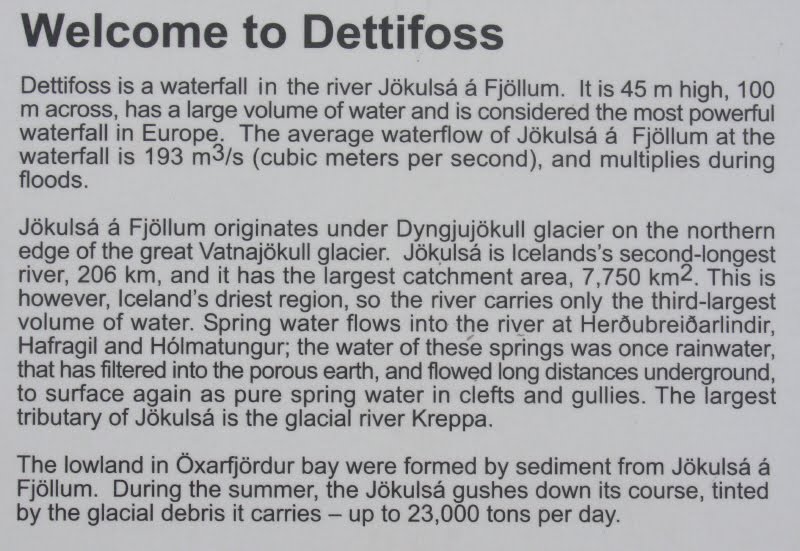
Being lazy and to save typing out the facts and figures for the waterfall, I've included this picture below -


.................. and the view downstream


It was quite a spectacle and real reminder of the power and force of nature. The journey back seemed quicker but maybe that was because we now knew how far it was etc. Returning back to the hotel, Sula and I took a walk for an hour around the shoreline just along from the hotel. Apart from the obvious numbers of ducks, another 'common' species was Slavonian Grebe. Around this part of the lake were numerous birds, many with young and were fairly approachable. The main problem was actually getting a clear view of the birds as there was quite a lot of vegetation along the shoreline.

Slavonian Grebe


       Robbie

Saturday, 21 August 2010

A 'Stormie' Night

  Returning home on Thursday 12th August, I was looking forward to a few quiet days getting back in to island life. I'd already sent out several texts to birding friends that I was home and if anything turned up to let me know. The following morning I got a call from Rory to say that he and a bird ringing friend of his were going out that night to tape lure petrels.

  I met Rory and Will at a headland in the north of Unst at just after 11pm. It was a very dark, cloudy night with a breezy on-shore wind. Will had only recently finished doing his PhD on Leach's Petrels and had spent the last four summers on St Kilda studying them. It was on St Kilda many years ago that I saw my first Leach's and is a memory still vivid in my memory. The sound of them flying around us on Carn Mor and even the occasional movement of air across the face as they brushed past is one I'll never forget.

The principal behind tape-luring is to play a recording of the species you are after and the call lures the bird(s) - hopefully into a carefully placed mist net. For those that have never come across one, a mist net is a fine meshed net strung up between two poles - a bit like a badminton net - and on it are a number of pockets or 'shelves' that the bird drops into when it hits the net. The bird can then be fairly easily removed for ringing.

  I must emphasize here, that I was only there as an observer as all tape luring and ringing is strictly controlled and licensed by the BTO (British Trust for Ornithology). It can take years to get a full ringing license and only then after many many hours of working with a qualified ringer. During the first night, I lay on the ground in the dark, straining my eyes looking up at the net for a shape the size of a large House Martin to fly in to the net. The main species that was hoped for was Leach's Storm Petrel as there isn't a huge amount of data on their distribution here on Shetland.The sound that Leach's make is a bit like the cartoon character 'Woody Woodpecker' makes, just add a bit of helium ! - Link here to the  Call .

  The first evening there were a least 26 Storm Petrels ringed but no Leach's, one 'bounced' out of the net and flew away unfortunately.

Ringing a Storm Petrel

  The following evening I went out with them again, this time with Sula my 10 year old. I was feeling rather tired but thought it was an experience for Sula not to miss - and we also may get to see a Leach's ! When we arrived a just after eleven pm, besides Will and Rory, there were 3 others from Unst - Alastair, Wendy and Mike, quite a party ! Due to the nets being close to the cliff edge, it was suggested that only two ringers at any one time should be by the nets and we should stay where the birds were ringed. Unlike the previous night, birds seemed to be coming in fairly frequently. For Sula it was a real bonus as once ringed, some of the birds were carefully handed to her to be released. After an hour or so, Sula was getting tired so I took her back up to the car for her to have a sleep in her sleeping bag. Finally around 12.45am, a Leach's was caught and brought down for ringing. Leach's are much bigger than 'Stormies' and also have a forked tail which gives them their alternative name of 'Leach's Forktailed Petrel'. It was here that things went pear shaped - for me at least ! I now know it was a wrong decision (how much wiser we are after the event !) in that I decided to used my 90mm macro lens as the subject was controlled and I could move in or out to get the best composition etc. What I hadn't checked was the lens working with the flash, or rather the lens auto focusing in the dark with the flash. It didn't !. I then had to try and manual focus using the available light from the head torches which wasn't a success. Almost all of the pictures from that evening were out of focus, it was my own fault and I may never get another chance to do it again - fingers crossed I do.

Leach's Petrel (taken using phone camera)

  Sula and I decided to leave around 3.15am as there was now a very faint glow on the horizon and the team would be packing up soon anyway. I believe that just after we left, another Leach's was ringed, making a total for this season on Shetland to 10 birds (9 on Unst and 1 on Fetlar) - they also went out the following evening, but we were away on West Mainland. Despite the camera problems, it was a great experience for both Sula and me so a big thank you goes out to Will and Rory for phoning in the first place.

                   Robbie


Thursday, 19 August 2010

Iceland Day 3

Wednesday 21st July


  After another very filling breakfast (buffet style and plenty of it) we packed the car up for the drive up to our next destination at Reykjahlid and our hotel on the edge of Lake Myvatn. The main roads on Iceland are great and so with stunning scenery all around at times it was difficult keep our eyes on the road ahead. After around an hour, we pulled in to a lay-by by a large roadside lake for a break and to take a look at  the magnificent scenery. The weather was warm and still and out on the water were a number of birds including a family of Greylag Geese and in the distance were two Great Northern Divers.


  It wasn't the creatures on the lake that were noticeable however, more the small ones that were flying around the edge - Black Flies. We were experiencing our first encounter with the small beastie that Iceland is renowned for and there were thousands. We found out later that they do get very bad in certain months, so this was just a few !


 Black Flies
  Even though they were a nuisance, here fortunately, they were only in small areas and once walked through, we were clear of them for a while. Moving on again, our next stop was at  the waterfalls at Fossholl. The water here from the river Skjálfandafljót falls from a height of 12 meters over a width of 30 meters and so we were told, is even more spectacular in late spring after the snow melts.


Goðafoss waterfalls

  Here, there was not much in the way of bird life again, however I did get a fly-over of a Great Northern Diver and several sightings of a male Merlin. Nearby a Whimbrel had a territory and kept getting anxious as people walked along the path to the falls until they had passed through its nesting area. With such a vast area to choose to breed, it does make me wonder why some birds choose to nest in such popular tourist places.

  Moving on again, we briefly stopped at the southern end of Lake Myvatn for lunch. It was now pretty warm and I could feel the sun burning on my neck - not something I'd felt on Unst for a while ! The place where stopped, was at a junction for one of the cross country tracks. The area really did remind me of some parts of Namibia and seeing the dust trails left by vehicles as they sped along the tracks made it even more so. It was difficult to work out, but I believe that there is a grading system from 'A' to 'F' according to the type of road, 'A' being a good, tarmac road; 'F' being the most difficult and for only specially prepared vehicles and experienced drivers. As we stood there, a group of 5 or 6 vehicles came off of the gravel on to the tarmac, the last one was a 'Hummer' on which the chassis had been raised and which I could have walked under it by only bending down !

  One of the species I particularly wanted to see was Harlequin Duck and unbeknown to me at the time, we were very close to the Laxa River, one of the easiest places to see them. Shortly after, we parked up beside the river and decided to take a walk  to try and find some. Due to the time of year, seeing a male in full breeding plumage was not going to happen, they will have departed for the open sea to moult weeks ago; as I already knew this, I was not going to be disappointed.
The Laxa river
  In no time at all, we had found our first Harlequin females, there were several birds feeding in the fast flowing water almost effortlessly.
 Female Harlequin Duck

  Carrying on up stream, we found a number of birds and most were quite confiding, possibly knowing they were safe in their element. In one part where the river split in two, part of the river was fairly calm and here we came across a number of Harlequin ducklings feeding. Even these little balls of feathers seemed to be in total control of their direction of travel when they ventured too near the white water. If the current was too strong, then they would 'run' across the water also using their wings as tiny paddles.


  Also in side streams that were much slower running, there were a number of feeding Rednecked Phalaropes and a family of Barrow's Goldeneye.

Barrow's Goldeneye

  I could have stayed there for the rest of the day,  but as they say 'time and tide stands till for no man' so we headed around the lake to the hotel at Reykjahlid.
  The view from the hotel where we stayed, is a view I'll never forget, the balcony on the 3rd floor had 180 degree view of the lake and we were just a few yards from the edge of it. Standing there as the sun sank below a low hill at 11.15pm, mirror calm water with Great Northern Divers calling is an atmosphere I can't describe.

  Once we'd settled in and had dinner, I decided to go back out again to a spot a few kilometers away and try and get some shots that, for me, would bring back the feeling of Myvatn. Like a lot of folk, I get bothered by flies and midges and like everyone else, I've tried a variety of insect repellents. I have seen some - containing 'deet' - blister plastic and soft rubber so I am obviously very careful what I use near my camera gear. After hearing others had been using a particular product, I decided to give it a try and have found it to be pretty effective and that's called 'Avon Skin So Soft'. I was using it on this particular evening and I have to say it was brilliant. Sitting in the grass at the waters edge, I was surrounded by Black Flies and had virtually none bother me and that went for midges too. I've since heard that the formula may have changed so it'll be interesting to see if it still works. Below are a few pictures from the evening, the first was taken at 9.30pm and the last with the sun going down was at 10.30pm. Almost all of the back-lit 'dots' are either midges or Black Flies which will give you some idea of the numbers.


                      Robbie.

Tuesday, 17 August 2010

Iceland, days 1 & 2

  My apologies for not posting recently, but as I mentioned in my last post, I was going to be away for over 3 weeks. I was unable to have a good look at the pics I'd taken on Iceland until I returned home and as I use photographs to jog my memory, I didn't want to post without any pictures. Returning to Unst last Thursday, I then had a few more hectic days and nights - more of that later in the week or earlier next week.


  'Wow' was one word I used regularly on arriving in Iceland recently and I still have the same feeling each time I look at some the pictures on getting back home. Our trip to Iceland was part of a family birthday celebration (my mother in laws 80th) and involved an awful lot of planning and I'm sure was a logistical nightmare (so a big thank you to Ian, Catriona and Stuart).


    I left Unst with the girls on the 16th July (Catriona had been working away and was in London) to catch the Friday night ferry from Lerwick to Aberdeen. The following day we travelled by train to Kings Cross station in London where we met Catriona. Both the ferry and train journey went smoothly and by 4.30pm on the Saturday we were in London. Even though I have worked in London in the past (on a weekly basis), it was a bit of a shock - well mostly the noise. Only a day and half previously we had been in the peace and tranquility of Baltasound where 'busy' is at the most, a dozen cars coming through when a ferry has arrived at Belmont ! We were staying not far from Clapham Common and, I have to admit, the 'urban jungle' wasn't too bad. It was a pleasantly warm evening so we had a picnic on the common with Swifts screaming overhead and a Great Spotted Woodpecker calling from some nearby trees.


  London was a good reminder for both myself and the girls, how lucky we are to live in such a fantastic place and is something that I, and hopefully the girls, will never take for granted.


  The following morning, we were on the move again, this time a tube and train journey to near Guildford to stay with relations for the night before our flight to Iceland from Gatwick on Monday 19th July. In the garden of the house where we were staying, we had loads of butterflies on a purple budlia including, Red Admiral, Peacock, Coma, Small Tortoiseshell and Silver Washed Fritillary .


Silver Washed Fritillary


  I can hear folk wondering why on earth we would go all the way to Gatwick, just to fly all the way back up to Iceland. There were several reasons and one was it was actually slightly cheaper, also because we had things to do in the south on our return. One other deciding factor regarding the airport for our outward flight was that when the booking was originally being made to go from Glasgow, the airline wanted  around £25 per ticket, to post the tickets to us,  that would have been almost £100 extra to send 4 tickets to the same address ! I could fill a whole page with other similar booking stories involving the airline(s) but I won't.


Monday 19th July


  The day had finally arrived, we were going to Iceland. Not somewhere that I'd ever considered for a trip (costs aside) but I still knew a bit about the place - primarily birds - and was now really looking forward to getting there. The flight to Keflavik airport (half an hour from Reykjavik ) was to be 2-1/2 hours and then we had to transfer to Reykjavik airport (are you confused ?, so was I ) for an internal flight later in the day to Akureyi ie transfered the north of Iceland. Ian had arranged for an airport transfer which, due to the flight being later, also took us to the 'Blue Lagoon' just north of Keflavik. I've heard Iceland described as the 'Land of Fire and Water' and the Blue Lagoon is a result of the two, ie hot springs.The Blue Lagoon is a commercial outdoor geothermic spa that is open all year with a  water temperature of around 37 degrees. For more info take a look here - http://www.bluelagoon.com/ . Catriona and the girls went in for a swim, while I spent most of the time walking around pools outside of the spa complex. To say that it looked barren is an understatement, but I liked it. I'm a fan of wide open spaces and Iceland has it in bucket loads. As to birds there, I only saw 3 species - Golden Plover, White Wagtail and LBB Gull. It was warm and sunny with a balmy temperature of around 18 degrees.


'The Blue Lagoon'

  The steam rising in the background is from a plant where the they tap into the hot water below the surface, this is then piped all over to provide very cheap hot water for industrial and domestic use. As you can see the water looks like watered down milk which is caused by the minerals etc in the water. This also creates a smell very similar to rotten eggs and is often present when you turn on the shower or hot tap - it took a couple of days to get used to ! The spa part of the lagoon system is to the right of the high mound of rock.

Sula in the 'Blue Lagoon'


  We were due to be picked up at 5pm from the Blue Lagoon and then be transfered to Reykjavik
airport for the flight up to Akureyri. Sure enough, at 5pm, the bus was there to take us on the half an hour drive to the airport and on the way I saw the first two of only a handful of starlings during our trip. At the airport I was surprised by the apparent lack of security to go through check in etc, but I'm sure it was still going on in the background. The flight to Akureyri was to take just over half an hour and I have to say was fantastic. The sky was fairly clear and we had good views of glaciers and mountains, lakes and valleys for most of the way north.


  Once landed, going through arrivals was straight forward and we were greeted by Selma, Lasse and Alan (the Danish part of the family). Soon after the hire car was sorted and we headed off into town following 'The Danes' up to our accommodation which was to be for two nights. It was a large residential school which during the summer is turned in to a hotel for visitors - and there was not a spot of graffiti or vandalism  in sight !  On the lawn below our 3rd floor room a Redwing was gathering food for a nearby nest and was quite confiding, although as we'd only just arrived, the camera gear was still in the luggage so no pictures were taken.


 Looking south towards part of Akureyri

  The hotel where we were staying is the large white flat roofed building a quarter of the way in from the left side. Akureyri has a population of just over 17,000 and boasts the worlds most northerly 18 hole golf course. After settling in to our rooms, we headed off down to the town centre for a meal. The first place was full so we headed just around the corner to a small restaurant that served Italian food. Despite the cost of a small beer being around £4.50, the food was really, really nice. I can't remember exactly what time we turned in, but it wasn't late - the sun was certainly still shining at around 10pm.


Tuesday 20th July


   It was a bright sunny day and after a good breakfast we were all heading off down the coast for a birthday picnic. Around town the common birds apart from the ever present gulls,  were Redwings, White Wagtails and occasionally Redpolls. The scenery all around was stunning, white snow topped mountains and long, finger like blue fjords. This part of Iceland seemed to be going through a mini heat wave as T shirts seemed to be the order of the day as the temperature reached the dizzy  heights of around 20C. After a relatively short drive, we turned off to a pretty little harbour  where we had the picnic. Bird life was in abundance, with Eider, Fulmar, Oystercatcher, Redshank, gulls and also numerous young White Wagtails. Along in the harbour, a fisherman was gutting his haul of fish and consequently had a large number of Fulmar in attendance. Each time he threw the fish remains in to the water, there was an explosion of birds towards the quickly sinking remains. Not having been on a trawler at sea, I hadn't seen this sort of behaviour before or even seen Fulmars diving underwater in pursuit of food which several did on this occasion.


Fulmar feeding frenzy

After lunch, we drove off a little further north to a view point over looking the sea where several of our group were lucky to get glimpses of a Minke whale some distance away, but I, unfortunately didn't see it.  Later on, on the return trip to Akureyri, we stopped off by the side of a large lagoon for a short while and it was here that we saw our first Rednecked Phalaropes of the trip. Where as Shetland has perhaps only a couple of dozen pairs of these lovely little birds, the breeding population on Iceland is thought to be around 50,000 pairs according to the Icelandic Birding Pages. At his location we had around 8 or 10 feeding close to the shoreline but out on the lagoon there were quite a few more. A large proportion of these appeared to be juveniles.

Rednecked Phalarope (juv)


Heading back to Akureryi later, we returned to our hotel for a while before heading out for an evening meal. Initially, Sula and I went down into the town centre to see if we could book a table at a restaurant which served traditional Icelandic food, this was not possible however - we would have to wait for a table to become available. Once we'd checked this out, Sula and I took a short walk down by the waterside and added Raven and Black Guillemot to our list before returning back again to the hotel to meet up with Catriona and Rona. We headed back down to the restaurant and fortunately for our rumbling stomachs, we didn't have long to wait for a table. I can't now remember what I had to eat, but I can remember there being 'Breast of Guillemot' and whale on the menu and, despite liking wild birds, I was sorely tempted to try the guillemot - but it was rather expensive ! Again we turned in sometime after 10pm, the sun was still shinning in a cloudless sky, I should have been out taking pictures but I was shattered - maybe tomorrow ?

                                  Robbie